Supreme Court Forms
Established 1994 - The First SCAO Approved Software in the United States
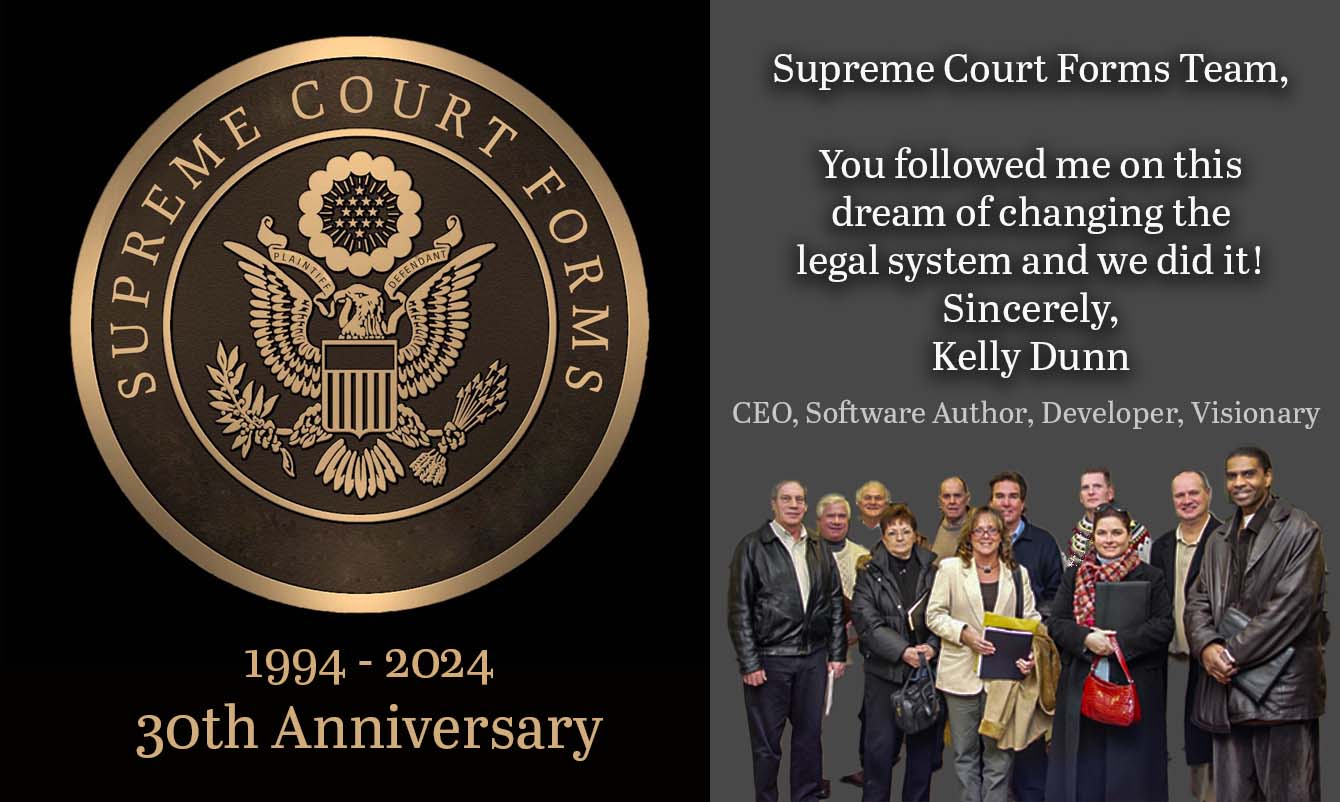
Legal Pioneer - Kelly Dunn
If you have ever used an electronic based court form, you can thank Kelly Dunn. Mr. Dunn was the originator and irst person to create a software program that was accepted by the Supreme Court. The first Supreme Court (SCAO) acceptance was in Lansing, Michigan. It took Mr. Dunn three years to convince the Supreme Court to accept printed forms originating from a computer. All forms up to this time were pre-printed, triplicate forms. The attorney, or most often the paralegal, would need to feed the pre-printed form through the back of a typewriter. For those of you that are younger you'll need to search, "typewriter". Kelly Dunn clerked for three years with a law firm in Troy, Michigan. Mr. Dunn would visit the judges chambers to have documents signed or picked up. Then he would go to one of the clerk's offices in Wayne, Oakland or Macomb County to have the paperwork time stamped. As time went on Mr. Dunn noticed the amount of pre-printed forms that were filling up in commercial dumpsters. These dumpsters were picked at the end of the week and taken to landfills. Kelly Dunn asked a of questions but nobody had the time or inclination to ponder. Legal forms cannot be submitted with white our of corrections. If there was one error the entire pre-printed document was pulled out of the typewriter and a blank, pre-printed form was inserted through the back of the typewriter. Kelly Dunn figured there was an entire forest of trees cut down every week, only to wind up in a dump or landfill. Kelly Dunn left the law firm and his pursuit of law to pursue the idea of creating the first electronic forms for the Supreme Court. The initial pushback was the fact that many law firms did not have a computer. Mr. Dunn replied that one day everyone will have a computer and their own printer. His ideas were scoffed at. One attorney went so far to say, "You have bastordized our legal profession!"
It took about a year for Kelyy Dunn to perfect the intial set of forms. Kelly Dunn knew many paralegals in Wayne, Oakland and Macomb County. He visited each of law firms and asked if they would be intertested in trying his new software. To his surprise many law firms did not have one computer system. Over time he found a few paralegals that owned a computer at home. Based on their feedback Mr. Dunn made the corrections and then would delier the next version. After three years the software was nearly perfect. He hired a few more programmers and taught them how to recreate the forms. Each form was coding from the ground up (Machine Language) so they program would load fast. The other idea included in the final version was the ability to save information within each form. This was a great idea as many law firms tend to do the same type of legal work, i.e., Personal Injury, Motions, Civil, District, Juvinlle etc. The end users found this to be a great time saver. Another feature was to edit the form on the screen without the need to start over like the pre-printed forms. This may seem rather obvious today but back in 1989 this was never heard of before.
The Legal Conference: Kelly Dunn rented a booth at a legal seminar in Ann Arbor, Michigan This was one of the largest conferences in the country to witness the premiere of Mr. Dunn's electronic software. Mr. Dunn brought two computers with his Supreme Court Forms software program installed on each system.
Mr. Dunn invited attendees to sit down and try the software. It was an immediate hit among the attorneys and paralegals. Soon, each vendor visited and tried the software. The was West Publishing, Lawayer's Cooperative, Blacks, Lexis-Nexis and many smaller publishers. Before the conference was over the representatives said they were given the permission to offer me a blank check. Mr. Dunn said he would like to sit down with West and discuss the options. West Publishing flew Mr. Dunn to Deerfield, Illinois. He was met at the Chicago airport by a limosouine to take him to their offices. West said they would like to purchase the source code. Mr. Dunn countered that he would prefer to retain the softare but to allow West exclusive marketing rights. Once the ink dried on the contract everything changed regarding electronic publishing in the law firms, courts and other compaines around the country.
1992 - West Publishing was purchased by Thompson Corporation for $3.43 billion dollars in cash. Thompsan became the leader provider of legal resarch materials in the United States.
2016 - Thompson Corporation was renamed, Thompson Reuters Westlaw.
From this point the success has grown for the past thirty years.
Our Mission

We have been a provider of custom electronic form software for more than 30 years. Previously our software solutions were marketed directly through West Publishing. Since 1992 our team has created some of the best electronic-based forms known in the industry. We listen to your needs and created a package suited for your firm. With our forms you can retrieve repetitive information. Fast and easy. We took the drudgery of filling out legal forms. Usually legal forms are updated twice a year. As a vetted vendor Supreme Court Forms obtain the forms before they are available to the public. When you use one of our legal forms you are assured it's up to date and, SCAO Approved.
Contact
Call (877) 888-6111 Before you call:
1. You must have an ID.ME account
2. You must have a referral number that is attached to your ID.Me
3. If you do not have an ID.ME account and/or referral number please call your contact supervisior to provide you proper identification.
Once you have been vetted and pass screening you will receive a verification code that is good for fifteen (15) minutes. Once your code has been submitted and confirmed you will be assigned an agent.
Address: PO BOX 232 Port Sanilac Michigan
Email: Inquiry@SupremeCourtForms.Org
MICHIGAN SUPREME COURT - SCAO FORMS PUBLISHERS - KELLY DUNN
DISCLAIMER: The Michigan Supreme Court is providing the information on this website as a public service. By using this website, you agree to comply with all of the terms of use listed in this section. Bulk data downloads and commercial uses of the data from this site are prohibited. The information posted on this website may include hypertext links to external websites and/or references to information or services created and maintained by other public and/or private organizations. The Michigan Supreme Court provides these links solely for user information and convenience, and not as endorsements of the products, services or views expressed. Users acknowledge that when selecting a link to an outside website, they are leaving this website and are subject to the accessibility, privacy and security policies of the owners/sponsors of the outside website. The Michigan Supreme Court will not be liable for any damages whatsoever resulting from the use of or in connection with this website or the associated linked websites. Although every effort is made to maintain accurate information on this website, the Michigan Supreme Court does not guarantee the accuracy, relevance, timeliness or completeness of information contained on or within this website or the associated external linked websites. Further, the Michigan Supreme Court does not warrant the ownership of internal or external website content, or that any of these websites will be free from interruptions in services or from computer viruses. To the extent that a user wishes to utilize copyrighted materials in linked websites, the user must request such authorization from the sponsors of each such website.